Thermal Analysis of Vertical Rectangular Fin Arrays Under Natural Convection Cooling
Introduction
Thermal management plays a critical role in the performance, efficiency, and longevity of electronic equipment. Excessive operating temperatures may lead to reduced reliability, accelerated material degradation, and eventual component failure. Passive cooling techniques using extended surfaces are extensively employed because of their simplicity, low cost, and absence of moving parts.
Among various heat dissipation methods, vertical rectangular fin arrays operating under natural convection are commonly used in electronic heat sinks. The heat transfer performance of such systems strongly depends on fin geometry, spacing, and orientation. Although increasing the number of fins enlarges the heat transfer surface area, excessively narrow spacing suppresses airflow between fins and reduces convective heat transfer. Conversely, very large spacing weakens the chimney effect and reduces the available surface area. Therefore, an optimum fin spacing exists that maximizes the overall heat transfer rate.
This article develops a complete thermal analysis of a vertical rectangular fin array subjected to natural convection. The study includes:
physical modeling of the fin geometry, estimation of optimum fin spacing, calculation of dimensionless parameters, evaluation of convection coefficients, and determination of total heat transfer rate.
The results are applicable to the thermal design of passive heat sinks for electronic systems.
Methodology
The present study investigates the thermal performance of vertical fin arrays operating under natural convection conditions for passive electronic cooling applications. The methodology combines analytical heat transfer modeling, fin efficiency evaluation, comparative geometry analysis, thermal resistance modeling, and computational parametric analysis using Python. A vertical array of uniformly spaced fins attached to a heated base surface is considered, where the fin base is maintained at a constant temperature while the surrounding air remains at ambient conditions. Thermophysical properties of air are evaluated at the film temperature using standard property tables from Incropera and DeWitt. The natural convection characteristics of the fin array are determined using classical dimensionless correlations involving the Rayleigh number, Nusselt number, and convection heat transfer coefficient for laminar flow over vertical surfaces. The optimum fin spacing is estimated using established empirical correlations for vertical parallel plates under natural convection, accounting for the interaction between buoyancy-driven airflow and thermal boundary layer development. To incorporate conduction effects within the fins, fin efficiency analysis is performed using standard extended-surface formulations. A comparative thermal analysis is conducted for rectangular, triangular, trapezoidal, and circular pin-fin geometries under identical operating conditions to evaluate differences in heat transfer performance and thermal resistance characteristics. The overall thermal resistance of the heat sink is subsequently evaluated to assess cooling effectiveness for electronic applications. Furthermore, a parametric investigation is carried out to examine the influence of fin spacing, fin thickness, and fin geometry on heat transfer rate, fin efficiency, and thermal resistance. All analytical calculations and parametric studies are implemented using Python programming language with NumPy, Pandas, and Matplotlib libraries for numerical computation, data processing, and graphical visualization. The adopted methodology provides a comprehensive framework for analyzing and optimizing passive fin-array heat sinks under natural convection cooling conditions.
Results and Discussion
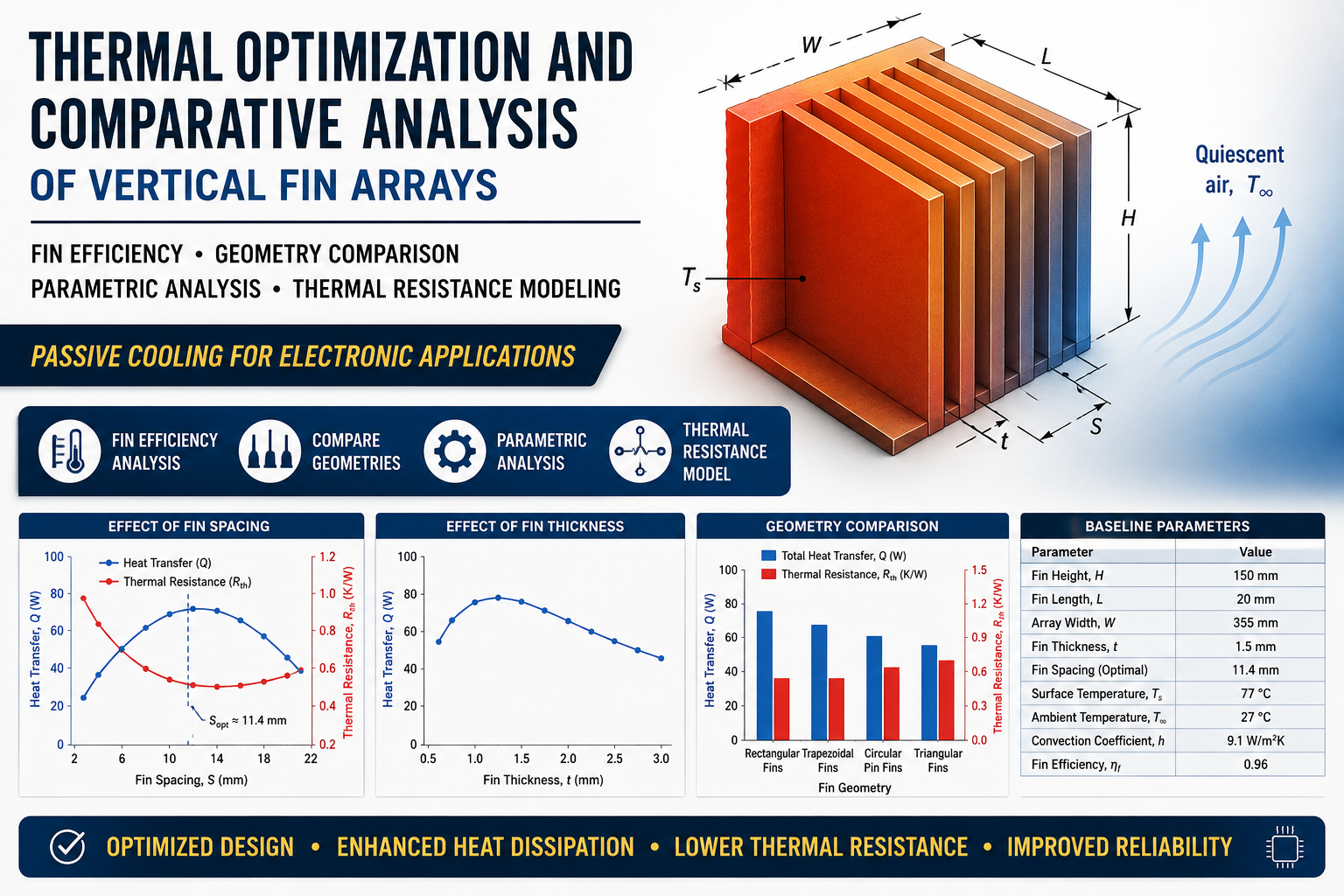
The results show that the rectangular plate-fin geometry dissipates the largest heat load among the investigated configurations. Its total heat transfer rate is approximately 69.84 W, while the corresponding thermal resistance is 0.716 K/W. The trapezoidal fin provides the second-best performance, followed by the circular pin-fin equivalent and the triangular tapered fin.
The fin efficiency analysis shows that the aluminum fins are highly efficient. Therefore, the dominant design factor is not conduction resistance inside the fin but rather external natural convection and available heat-transfer area. This explains why reducing fin thickness improves heat transfer in the studied range: thinner fins allow more fins to be installed within the same array width.
The spacing analysis confirms the importance of geometric optimization. Although smaller spacing increases the total surface area, overly small flow passages may restrict natural convection. Hence, heat-sink design should not simply maximize the number of fins; it should instead optimize the coupled conduction--convection system.
Conclusion
A classical vertical fin-array problem was modified into a broader thermal optimization study including fin efficiency, geometry comparison, parametric analysis, and thermal resistance modeling. The main conclusions are as follows:
The calculated optimum spacing for the specified conditions is approximately 11.36 mm. The rectangular plate-fin geometry gives the largest heat dissipation, approximately 69.84 W. The corresponding thermal resistance of the rectangular fin array is approximately 0.716 K/W. Fin efficiency for the aluminum rectangular fin is high, approximately 0.994. Fin spacing and thickness significantly influence the thermal performance of passive heat sinks. Python-based analysis is effective for preliminary heat-sink design and optimization.
References
- [1] F. P. Incropera, D. P. DeWitt, T. L. Bergman, and A. S. Lavine, Fundamentals of Heat and Mass Transfer. Wiley.
- [2] J. P. Holman, Heat Transfer. McGraw-Hill.
- [3] Y. A. Çengel and A. J. Ghajar, Heat and Mass Transfer: Fundamentals and Applications. McGraw-Hill.
- [4] A. D. Kraus, A. Aziz, and J. Welty, Extended Surface Heat Transfer. Wiley.
- [5] A. Bar-Cohen and W. M. Rohsenow, “Thermally optimum spacing of vertical, natural convection cooled, parallel plates,” Journal of Heat Transfer.
- [6] F. P. Incropera, D. P. DeWitt, T. L. Bergman, andA. S. Lavine, Introduction to Heat Transfer, 5th ed.,John Wiley & Sons, 2007.